

Artist Lucia Ferrara presents the work “Tav 4” (Plate 4), part of the larger painting cycle of the *NEVER PERFECT* project—launched in 2017—for which the artist holds all rights.
Acrylic on canvas, dimensions 240 x 200 cm.
*Never Perfect* is a social and museum-oriented project, but also a commitment—a mission to bring people closer to human stories through art.
The *Never Perfect* project is a story told through images; as such, it follows a structural logic similar to that of a book or a fable, and this is how it will be presented on DNheArt.
We are back with a new installment on DNheArt featuring a new canvas from the project: this time, we are discussing “Tav 4.”
Who among us, in the course of our lives, has not experienced the difficulty of living?
This project addresses pain, trauma, and the need to “see” the painful parts of our personal and human histories in order to transform them into positive exceptions.
What happens in our psyche when we suffer a “fracture”?
Traumatic events have the power to impact our lives in a matter of moments, yet their effects can endure for a lifetime.
When we speak of a wound, we naturally tend to think of a cut and the resulting blood; however, when we speak of a fracture, we intuitively understand that the damage caused may be invisible and deep-seated, yet no less significant.
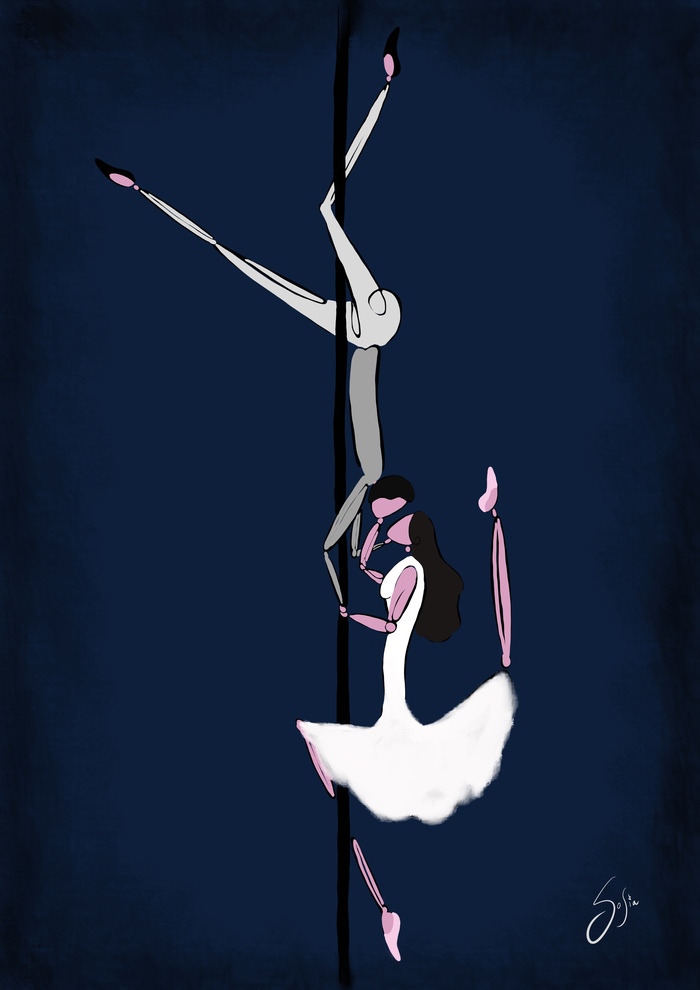
Let us remember that trauma divides our existence into two moments: the time before the event and the time after. This compels us to question everything we are—our values, our lifestyle, our desires, and our emotions. That is why, in Plate 4, the artist depicts two people—two sides of the same coin: one ready to take action upon herself, the other poised to endure, deciding whether to succumb to pain or find the strength to fight back.
For to fight back, one must reclaim the word “future”—one step at a time—and choose to live, or at least survive: changed and different, yet always unique. One rarely discusses, in the wake of trauma, how to bridge the past and the present, how to let go and realize that a single event cannot—indeed, *must* not—destroy all future possibilities. It is a deeply complex journey.
It takes courage to remember.
The work portrays an existential crisis—an inner conflict that calls into question one’s identity, values, and sense of purpose. It captures a harrowing human experience that may involve depression, anxiety, confusion, and profound bitterness.
Another central element is the theme of death—specifically the contrast between life and death embodied by the two women, who seem engaged in a dance—or a struggle—between the two states.
It is a theme we confront with anguish and fear, even though it is an intrinsic part of our existence; we try to delude ourselves that “living” has nothing to do with dying, yet life and death are opposing yet close forces—contraries that embrace and merge with one another.
By navigating our own fractures and the very fear of the word “death,” we can learn to accept our physical and psychological limitations.
The artist holds the deep conviction that true happiness resides within the heart and cannot be destroyed by events—for events are unpredictable. Despite their tragic nature, she believes we must seek refuge in the blue of the sky and the canvas, finding the resolve to fight every day for truth and rebirth.
Lucia Ferrara
CONTACTS
Lucia Ferrara
Email: luciaferraraofficial@gmail.com
www.luciaferraraart.com